 Login
Login
By Rebecca Underwood
“Children come to know the past through the people they love, the stories they hear, and the places they belong.”
When you make space for history in the early years, you are doing more than preparing children for Key Stage 1. You are giving them the tools to make sense of the world. To recognise lives lived differently from their own. To find belonging in shared experience. To see value in stories that feel both familiar and new.
History in the early years is the gentle layering of experiences that help children understand who they are, where they’ve come from, and how their story fits alongside others.
When children talk about their early childhood, notice what has changed, or listen to a grandparent’s story, they’re doing something powerful. They’re beginning to see time not as an abstract idea, but as a living thread – woven through birthdays, family routines, shared stories and seasonal rituals. These threads are the beginnings of historical consciousness.
When children are given time to talk, to wonder, to revisit, and to remember, they begin to understand the passage of time not through abstract facts but through lived experience. They begin to piece together their own stories – what came before, what is now, and what might come next.
What you carefully ‘build’ in Reception shapes all that follows. These earliest understandings form the groundwork of historical thinking. Without them, later learning has nothing to ‘rest’ on. The stories of kings and queens, battles and inventions, lose meaning if children cannot first see how their own lives fit into a wider picture.
History depends on connection. And connection depends on early understanding.
Without this foundation, history is left floating – disconnected from the child’s sense of self, time, and place. But with it, history takes root in the child’s mind ; anchored, meaningful, and quietly becoming part of who they are.
This matters. Deeply. You are helping them notice, remember, compare, reflect, question, connect, imagine, and recall. You are building identity – layer by layer, word by word, moment by moment.
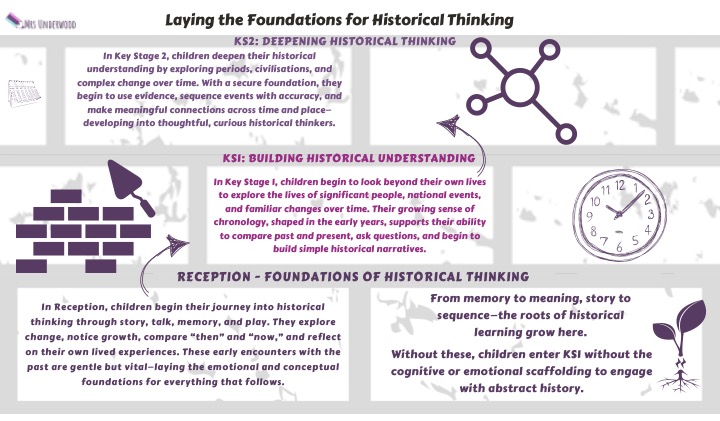
Diagram 5: The development of historical thinking from the foundations laid in Reception to the deepening complexity of Key Stage 2. It shows how memory, talk, and play in the early years provide the emotional and conceptual scaffolding children need to engage meaningfully with the past as they move through school.
In Summary: “The story has already started. Our role is to notice the thread and hold it steady.”
When we step back, it becomes clear: history in the Reception classroom is a story already in motion, woven through the everyday. It starts with the child: in their memories, their milestones, their moments of wondering. It lives in the way they notice change, recall what came before, and begin to place themselves within a much wider world.
We have explored how history weaves its way through story, play, conversation, and daily routines. We know that history in the early years doesn’t rely on artefacts from long ago or formal knowledge of distant times. It thrives in the real and the familiar; in the birthday photos, the family traditions, the questions children ask when they are given space to speak.
The EYFS framework offers everything you need to nurture historical thinking: meaningful interactions, rich language, diverse stories, and the freedom to explore through play. Your role is to hold the thread, between then and now, between the child and the world, and to keep it strong, visible…. and alive.
- It lives in quiet moments and joyful ones.
- In questions asked at the snack table.
- In memories shared during circle time.
- In stories that carry time in their pages.
This is powerful work. Gentle, but lasting. And with you walking beside them – through the language you model, the memories you share, the questions you make space for… you help their sense of the past grow strong and real. What a privilege.
You are not simply laying foundations.
You are shaping the story they will carry with them – through school, through life, through who they become.