This session was recorded on Tuesday, 30th June 2026. Answers and comments may be in reference to the chat feed which you cannot see and therefore could seem out of context. You may use this session in your own school including all approaches, ideas and shared resources. You may NOT share these more widely without express written permission from Mr T does Primary History Ltd. This can be requested by emailing stuart@mrtdoeshistory.com with the subject: Summer Network Sharing.
This term’s network focused on where next for primary history with a focus on the use of artefacts and retrieval.
The sessions are priced so reasonably to ensure as many teachers can access it as possible. This is impossible if people share the resources. Thank you for your cooperation.
Giveaway: This session was generously sponsored by Wildgoose Education and Starbeck Education who provided a £50 voucher for one lucky winner and a 10% off discount for all purchases using the code Summer10 which is valid until the 30th September 2026. They have an extensive collection of printable and tangible resources for history and subjects across the foundation curriculum. Genuinely, they are my first stop when purchasing artefacts, maps and more for my history work or when teaching.
You can find their extensive collections on their websites: Starbeck Wildgoose
Discount code: The networks are always free to paid website members but I know some people prefer to buy a ticket to individual sessions. With that in mind, the Autumn session will be an in-depth analysis of the draft National Curriculum update which launches for consultation in September. For 25% off the ticket price, please enter the code: CurricDraft (valid until September 2nd).
This session was recorded on Tuesday 24th March, 2026. Answers and comments may be in reference to the chat feed which you cannot see and therefore could seem out of context. You may use this session in your own school including all approaches, ideas and shared resources. You may NOT share these more widely without express written permission from Mr T does Primary History Ltd. This can be requested by emailing stuart@mrtdoeshistory.com with the subject: Spring Network Sharing.
The sessions are priced so reasonably to ensure as many teachers can access it as possible. This is impossible if people share the resources. Thank you for your cooperation.
(Please note: this was recorded from my teaching school so the acoustics may appear a tad different)
I was joined by Glenn Carter to focus on where next for primary history. We considered key aspects of pedagogy (inclusion, AI) then how we may scaffold learning!
This term’s network meeting focused on what it means to use historian’s interpretations in primary classrooms. Glenn and I focused on the building blocks which lay the foundations across EYFS and KS1. Our special guest, Emmy Quinn, then shared how we may implement the work of historian’s at the heart of enquiries.
The live session was recorded on the 13th November 2025. Comments and responses may be made in reference to the chat box therefore may mean they sound out of context. The book giveaway was done off screen because of time constraints and, because of GDPR, I cannot share the document that the names were linked to.
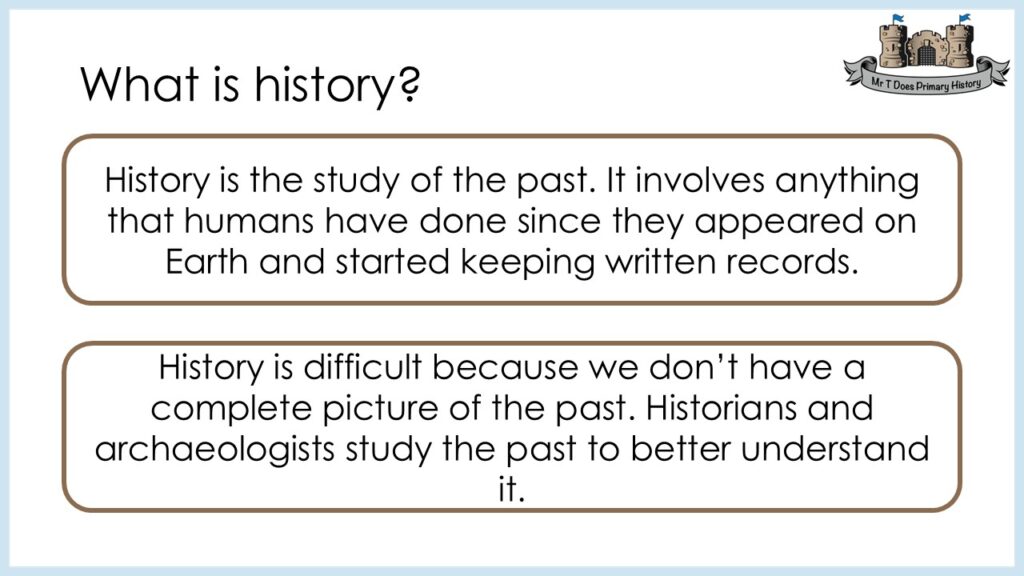
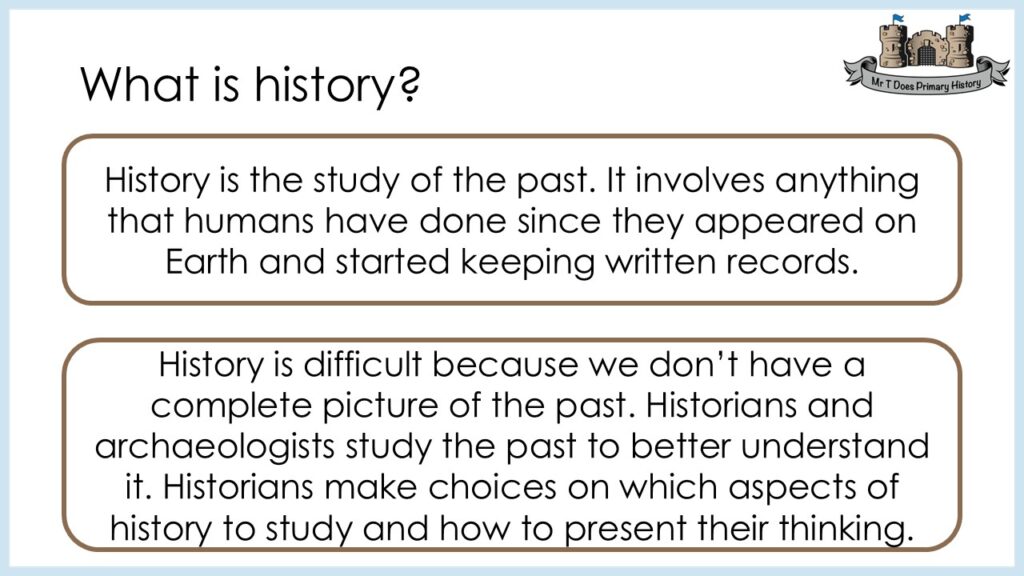
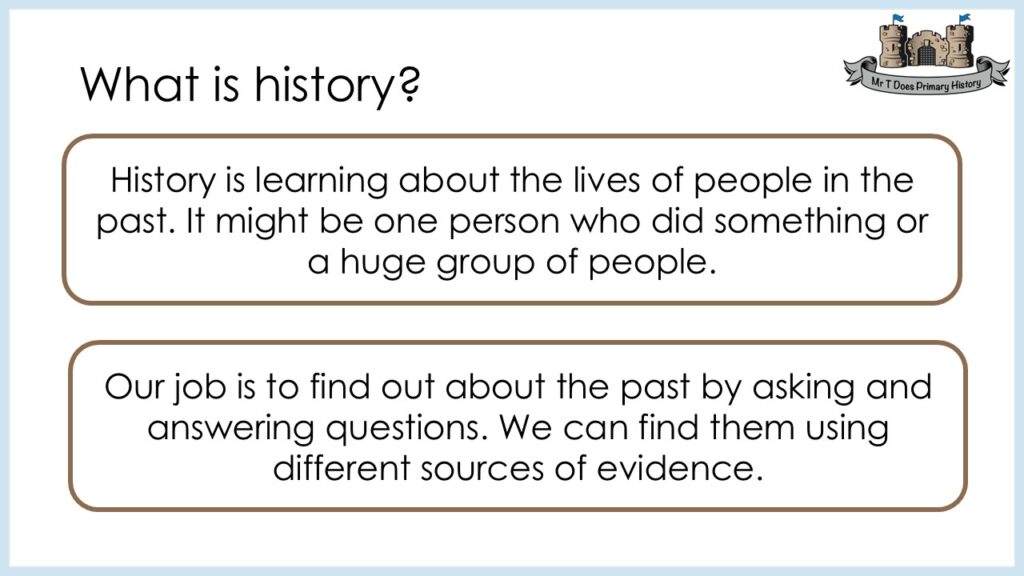
What is history?
In this session, Stuart introduced and shared how we may develop a definition for what children might view history as across KS1 to UKS2. It can then be supported with how history is studied to progressively introduce children to the nature of the historical discipline in a contextual and developmental manner. The images he shared are freely downloadable as image documents. This is a draft and needs further development and refinement…
Book Giveaway:
In this session, I gave away a copy of Totally Chaotic History by Greg Jenner. These books are magnificent at supporting children with what is thought about periods of history at an appropriate level. However, their true genius lies in the expert interruptions by specialists who precisely explain how and why we think that way. It is the book we have needed… a historian writing for primary children without just emphasising the gruesome, gory and silly out of context!
I just wanted to send a quick email to say how fantastic the resources and planning are for your recent unit on Ancient Greece. So far, I have only done the first session, but have prepared/read through the second session and it is so pleasing that I have very little to do for it!!
The kids loved the lesson style - so much time to chat and dig deep into proper history talk and I feel their learning will progress so much more satisfactorily because of all this.
A. Amos – Teacher, Leeds
Your visit was really inspiring, and having a pair of impartial eyes to look over our curriculum and books is just what we needed. We have really clear points going forward on how we can improve. Staff were so positive about the training too, something for everyone to take away. I'll be doing a follow up staff meeting in a few weeks.
You are genuinely brilliant at what you do and it was great to chat with a fellow history nerd! Really appreciate the documents you have sent over too, very generous.
N. Evans – History Lead
Really informative, great ideas, helpful advise and some fab resources. Thank you so much
C. Fielder, Curriculum Lead, Milton Keynes
We had a training day today; it was both fun and very inspirational. Lots of sensible and clear ideas to make History more engaging and purposeful for pupils.
A. Wells, Deputy Headteacher, Lincolnshire
I can’t recommend Mr T does Primary History enough. I am new to leading this particular subject and I left his training today feeling completely inspired. Thanks again Mr T
Louise Hill, History Subject Lead
Just purchased the Ancient Greek unit plan for 3/4 and its excellent! Certainly made my planning a lot easier! Many thanks, look forward to buying other units throughout the year!
I. Fern, Teacher
Awesome day spent with Mr T today going through our books and curriculum with a fine tooth comb. Great to know we were on the right track and to get clarity and direction on what we weren't sure about. Great staff meeting about how to use historical sources in a range of ways across the year groups.
H. Doust, History Subject Lead, Kirton Lindsey School
 Login
Login